
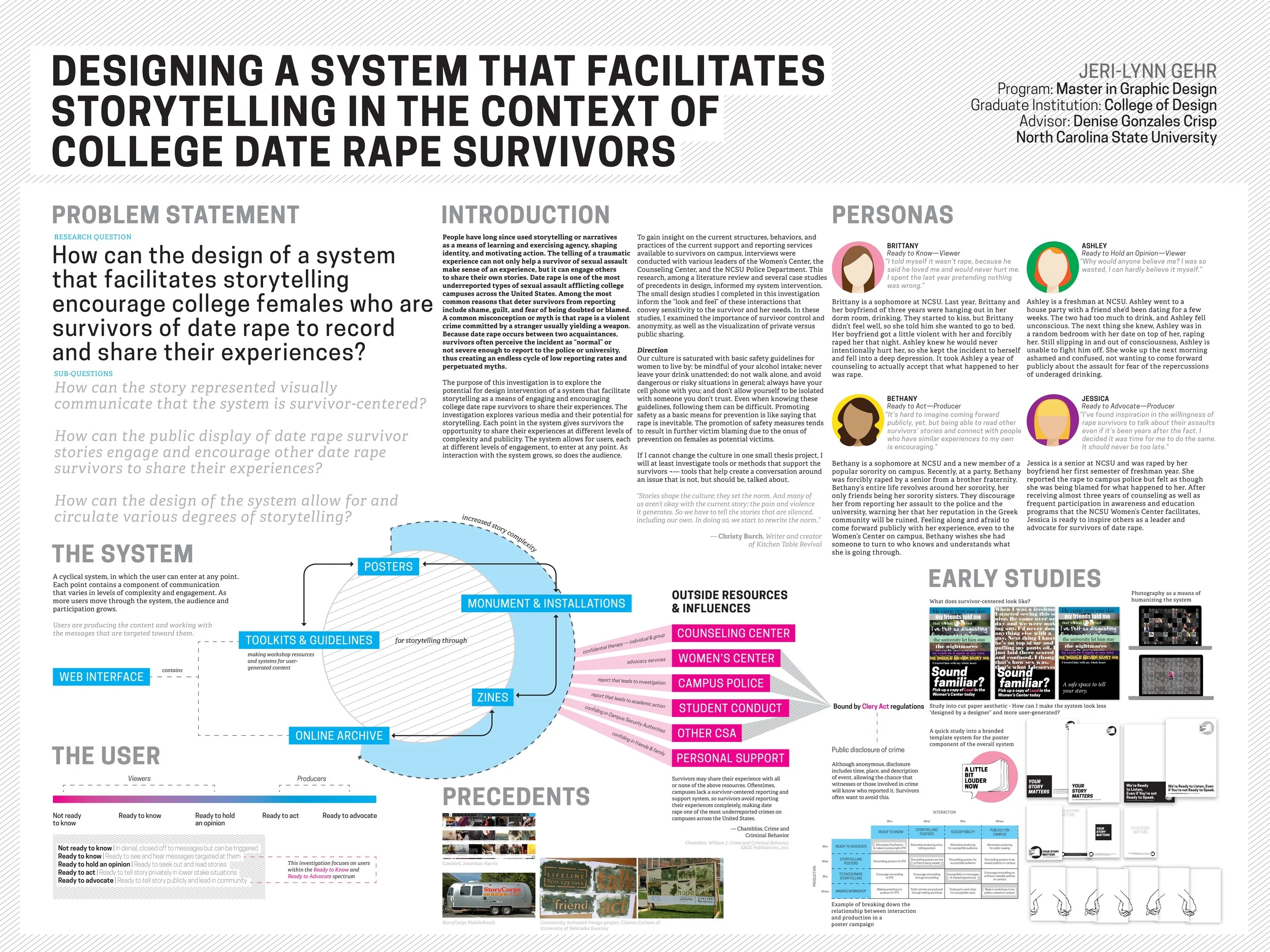
Master thesis project | Designing a system that facilitates storytelling in the context of college-aged date rape survivors
People have long used storytelling or narratives as a means of learning and exercising agency, shaping identity, and motivating action. For instance, the telling of a traumatic experience can not only help a survivor of sexual assault make sense of an experience but can prompt others to share their own stories. Date rape is one of the most underreported types of sexual assault afflicting college campuses across the United States. Because date rape occurs between two acquaintances, survivors often perceive the incident as “normal” or not severe enough to report to the police or university, thus creating an endless cycle of low reporting rates and perpetuated myths.
This year-long investigation explores the potential for design intervention into a system that facilitates storytelling as a means of engaging and encouraging college date rape survivors to share their experiences. The system employs methods from Participatory Design practices, giving survivors the tools necessary to tell their personal stories. The project explores the visual limitations and opportunities for storytelling through various communication channels. In these studies, I examine the importance of survivor control and anonymity, as well as the impact various degrees of privacy have on the survivor’s decision to share her story.
This investigation really just scratches the surface of the vast opportunities that graphic design offers for storytelling. I've included a few excerpts of the small studies I conducted. For more, please view the full document here.
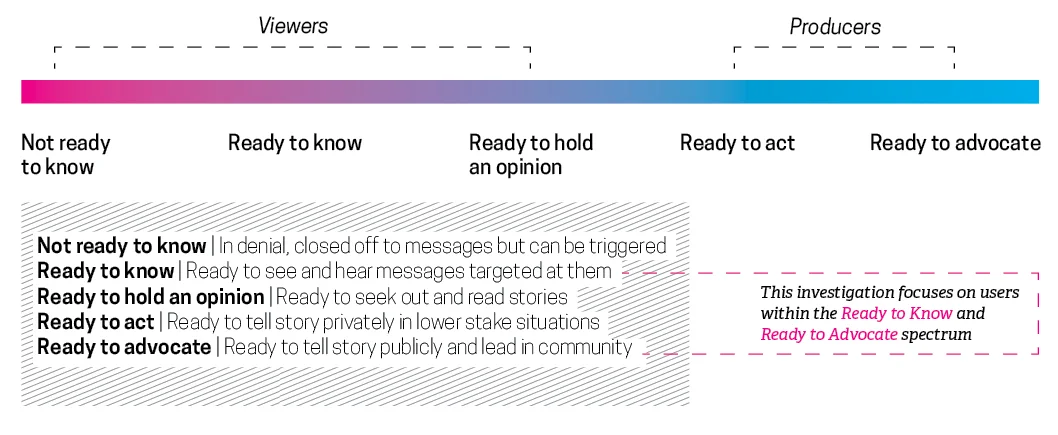
Idea Receptivity Gradient, Davis Rose
The following personas are based on the compilation of three variables, including: typical behaviors that date rape survivors exhibit, which are similar to individuals suffering from Post Traumatic Stress Disorder; actual date rape survivors stories represented in news articles and anonymous survivor story blogs; an analysis of David Rose’s Idea Receptivity Gradient (above). Rose’s scale provides a range of levels of participation, or engagement, starting at Not Ready to Know and progressing to Ready to Advocate. Growth in receptivity typically happens incrementally rather than all at once.
I analyzed the characteristics of each user on the Receptivity Gradient and, for the purpose of this study, divided them into viewers and producers. Users who are Not Ready to Know, Ready to Know, and Ready to Hold an Opinion are likely to be viewers of messages that users who are Ready to Act and Ready to Advocate produce. The largest difference between Ready to know and Ready to Hold an Opinion is an information-seeking behavior. Users who are Ready to Know are susceptible to messages targeted at them, while users who are Ready to Hold an Opinion, actively seek out messages. Users who are Ready to Act differ with those who are advocates by the perceived level of stakes involved in telling her story. Ready to Act users are likely to share their stories in environments that offer higher degrees of privacy, such as the web archive.
The purpose of this investigation is to design a system that facilitates a user’s ability to move through Rose’s stages of receptivity from Ready to Know to Ready to Advocate. Each system component varies in the level of story complexity and degree of public and private engagement, thereby influencing the degree of user engagement and interaction.
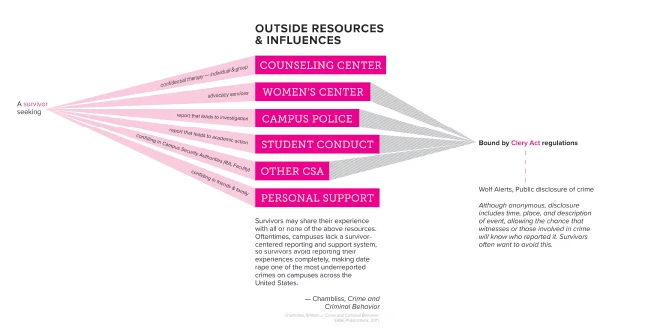
The map illustrates a list of possible resources available to rape survivors. A survivor’s decision to seek out a specific resource depends on the desired outcome or service. For example, a survivor seeking emotional support may go to individual or group therapy at the Counseling Center, but one seeking academic punishment for the offender will go to the Office of Student Conduct.
The Proposed System
The practice of storytelling evolved from the discovery that reporting rape to the police and university may not be the most important or productive method in becoming part of a larger solution. Except in the case of Sergeant Hammonds of the NC State police department, whose job is to provide a safe environment by removing criminals from the community, the main priority of the leaders in the Women’s Center and the Counseling Center is to provide a survivor-centered environment for date rape survivors. ‘Survivor-centered’ in this context means providing a space, free of victim-blaming and doubt, where survivors feel safe to talk about their experiences. In a traumatic event such as date rape, where control is often seized from the survivor, survivor-centered means allowing the survivor to decide if, when, or how she will tell her story. The lack of control survivors feel in the aftermath of university reporting processes often deters survivors from reporting at all. The system I propose in this investigation, based on the principles of Participatory Design, provides a space for survivors to share their experiences through different communication channels as a means of communicating to each other, “You are not alone,” while raising awareness to the university and public about the scale of the problem.
The proposed system, one that facilitates storytelling, is essentially comprised of separate ‘stages’ or platforms for users to share their stories. The system is cyclical in the sense that users who are Ready to Act and Advocate share their stories, encouraging Ready to Know and Ready to Hold an Opinion users to read them and share their own, thus moving them up through the gradient. I propose that, due to the varied level of engagement the target users possess, the components—a poster campaign, zine, web archive, and monument project—are necessary as a system. Each entry point varies in degree of privacy, interaction, and level of story complexity. The system, as a whole, acts as a ‘net’ to ‘catch’ each user who varies in levels of engagement or message receptivity.
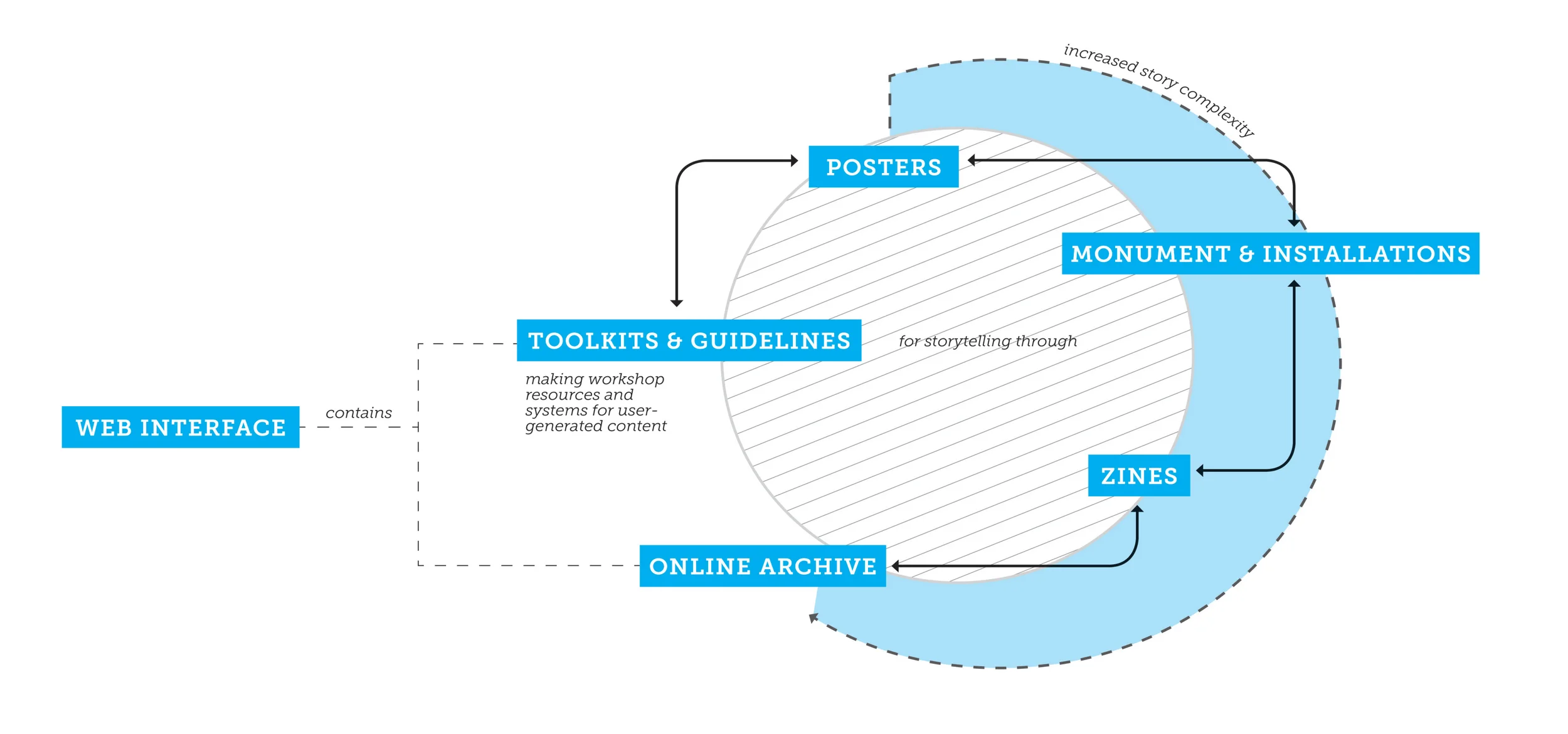
A map of the proposed system, containing different platforms for storytelling.
Poster Campaign
Posters were one of the earliest forms of mass communication, traditionally making their main function a quick attraction of the viewer’s attention (Rivers, 8). The nature of the poster’s form allows for a low level of story complexity and a high level of publicity. Posters function well as a means for increasing levels of education and are likely to engage survivors who are Ready to Know or ready to accept they were raped. (Konradi, 978).
Zine
Zines are self-published and self-circulated magazines, usually driven by passion and the desire to express. They often give voices to marginalized communities by eliminating the restrictions of publishers, editors, and distributors. This elimination allows for high authorship and ownership of the content. Zines can be produced individually or collaboratively and are usually viewed privately, allowing for contemplation and reflection.
Usually circulated to limited audiences, zines offer a higher degree of privacy for storytelling in the sense that they are distributed and traded amongst the community members they represent. If the zine is a collaborative effort, it is not unusual that only contributors receive copies. This restricted nature of distribution fosters expressiveness amongst zine-makers, which allows for various levels of story complexity. For example, contributors and creators of zines often use the format to express their stories through photography, poetry, or other art forms, but they may also use the zine as a journal, by writing their stories in a linear narrative form. The visual representation of the story allows for varying levels of interpretation from the viewer.
Web Archive
A web archive is a collection of stories, which allows audiences to view stories as part of a larger phenomenon. Individuals who tell personal stories through web interfaces often perceive the telling experience as inward and intimate. The medium allows them to tell their stories in their entirety while providing a heightened sense of privacy, especially if the environment appeals to or is restricted to a specific public (Dimond, Dye, LaRose, & Bruckman, 3). The reflective nature of storytelling in a web archive allows users to label, identify, and even change how they perceive their experiences.
Monument Project
The term ‘monument project’ was influenced by a current crowd-sourced installation called the Monument Quilt. Other than the Monument Quilt, there is currently no monument dedicated to survivors of rape and sexual violence. Monument projects, or installations, are projects that demand large public spaces for individuals to tell their stories. The stories vary in degree of complexity, which is dependent on the form of the project. They can vary from highly abstract and expressive to written in detail. The goal of a monument project is to use scale to attract viewers to come closer and potentially interact with it. Monument projects are extremely public and invite a new viewer to the system: the campus community. They raise awareness and promote dialogue amongst viewers outside of the survivor community. The monument project’s public nature can deter users who are not Ready to Advocate from telling their stories through the medium.
SMALL STUDIEs
Photography Studies
I explored the use of photography as a means of communicating that the system is survivor-centered. For the purpose of the documentation of this study, I protected the privacy of my photography subjects by adding illustrations over their images.
Photography is often used to create an identity for marginalized communities. It puts a face to a statistic. Photography adds a sense of vulnerability to the storyteller, especially in stigmatized cases like sexual assault. Sharing a rape experience is extremely courageous, and displaying one’s face alongside that story is even braver. Photography, when applied systematically, can communicate to date rape survivors that the system is survivor-centered. The women’s’ willingness to physically identify themselves in company with their stories, suggests that the system is free of victim-blaming, judgment, and doubt.
The decision to illustrate the images of females into photographs was not an easy one. After seeing their images in context, some of the women I photographed for this study felt uncomfortable being documented as date rape survivors. The revelation of this was surprising but interesting. It demonstrated the need for investigations like this. Rape is such a stigmatized issue that even some non-survivors are uncomfortable being labeled as survivors.
Regardless of the change of course, the illustrations provided a new opportunity I did not foresee. They provide a sense of identity paired with a level of anonymity that photography did not provide. The illustrations project a sense of reflectiveness in the sense that their faceless bodies could be anyone, just like date rape can happen to anyone. They also broaden the sense of privacy amongst the system components, offering lower levels of engagement the opportunity to advance more quickly. For example, Bethany, who is Ready to Act, is encouraged to share her story through a poster, which is generally seen as a higher stakes experience. The anonymity of the figures appeals to her desire to share her experience in a more private setting.
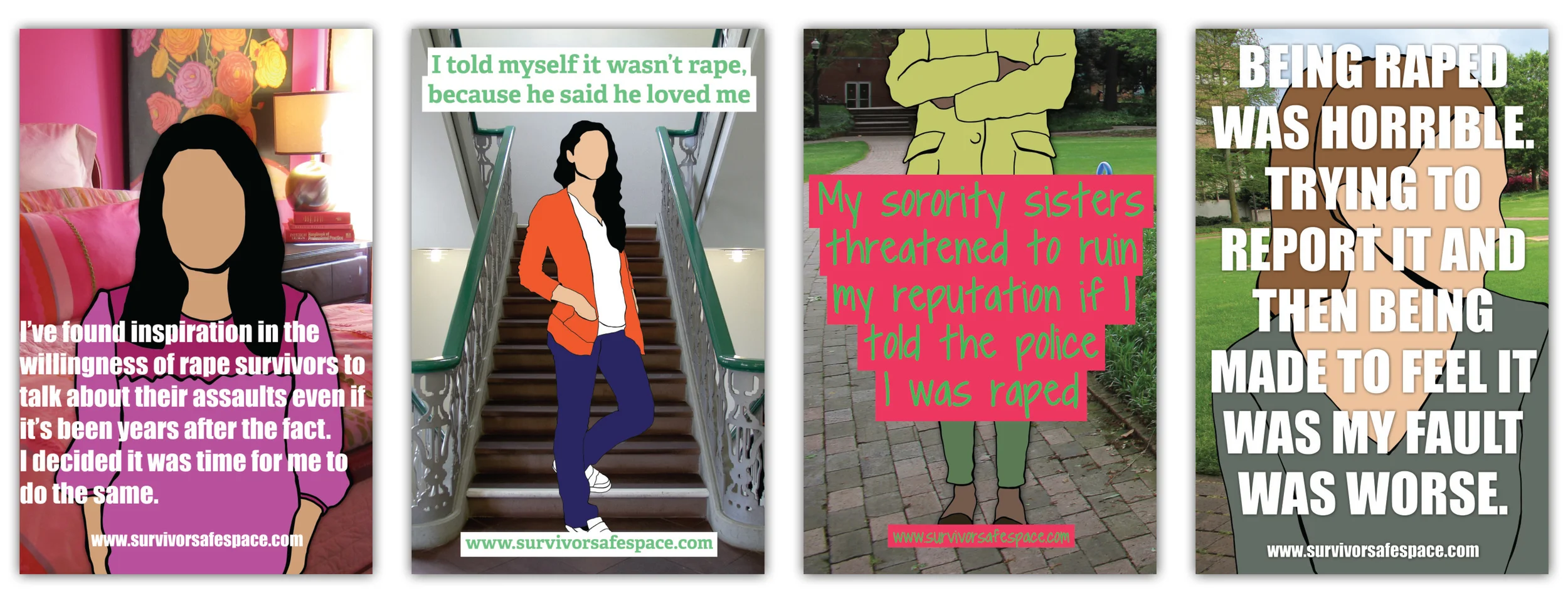
Examples of photography in a poster campaign context.
Users create the following poster campaign with software similar to photo editing and personalization platforms like Snapchat. Users can upload their photos to the platform, where they are given a set of tools to personalize their messages. The tools include a limited number of typefaces—a handwritten font, a bold san serif, and a serif. Users are given the functions to resize, change the color, and add a highlight to their text. The personalization function adds a sense of control and expression to the story. This aspect also allows the user to control how vulnerable or visually exposed she wants to appear .
Everyday, Brittany, a Ready to Know user, walks past a bulletin board filled with posters of survivor stories. She is not ready to tell her story yet, but the varied sense of privacy the poster designs propose, intrigue her. One day, she decides to approach the bulletin board and examine the stories more closely. The perceived option of privacy motivated Brittany to stop and read the survivor stories, advancing her to Ready to Hold an Opinion.
Rather than the standard saddle-stitched book-like format, I explored the different forms a zine could take. I was inspired by the accordion format of the zine. When collaboratively applied to an accordion booklet, photography and stories sit side-by-side, demonstrating a sense of collective action.
Photography posters on a bulletin board on campus.
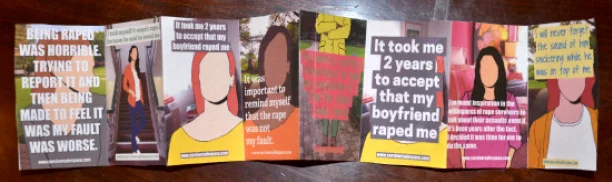
The accordion format of the zine creates a visual representation of collective action.
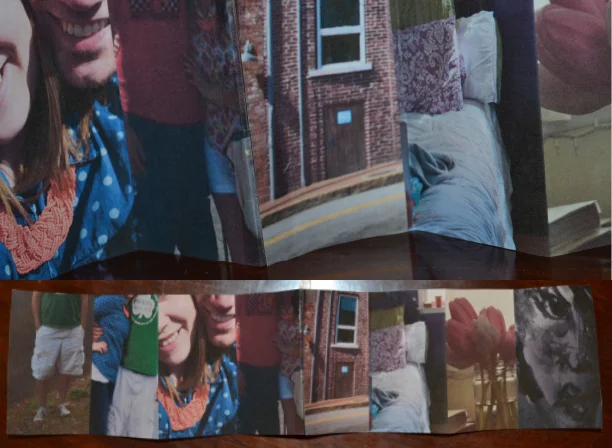
In this sense, the photography allows for a sense of authenticity in the storytelling. It also demands interpretation from the viewer.
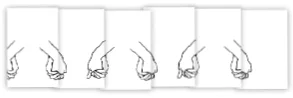
What would it look like if the posters interacted with each other? What if to tell a full story, you needed each piece? What does community look like?
I also investigated the accordion’s potential to demonstrate how a story can literally unfold. Zines often display stories in the form of artwork and poetry. They are an intimate form of storytelling, limited to a restricted audience that allows for reflection and inwardness. This reflection occurs in the making of the zine and in the reading of others’.
The following study illustrates a zine created by an individual with the use of photography to tell the story (Figure 5.6). Bethany, a user who is Ready to Act, trades zines with her fellow members of the support group she attends at the Counseling Center. Bethany and her support group use a template provided in the system’s online interface, to create their zines. They import personal photos into the template where clear instructions are given regarding printing and assembly.
Bethany tells her story through a series of photos that lays out her rape chronologically, starting with an image of her attacker—her ex boyfriend. Although she has accepted the incident as rape, she still sympathizes with him and is uncomfortable revealing his full identity. The zine template is restrictive in size and proportion. Due to the proportions, the template ultimately crops the photos Bethany uploads. She must make decisions about the visual representation of her story. By contemplating on what is and is not important in the telling of her story, Bethany is forced to reflect on her experience. She prints enough copies to trade with her group therapy members.
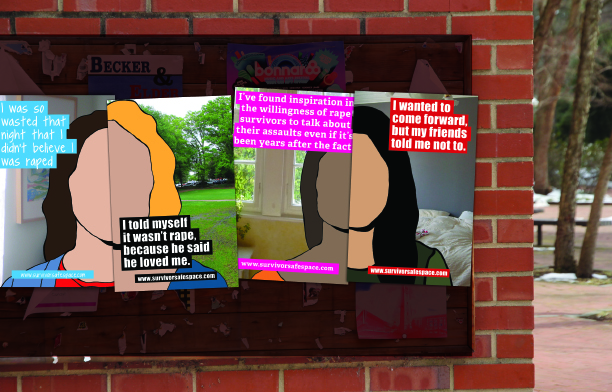
Example of posters that interact with each other, implying a sense of unity. This is more successful in an illustrative form where the subjects are anonymous. The original photographs illustrated a ‘monster-like’ feel.
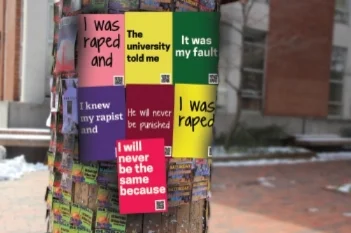
Posters that ‘talk’ to each other. Each poster contains a QR code that leads to the web archive, where a viewer can read the story in its entirety.
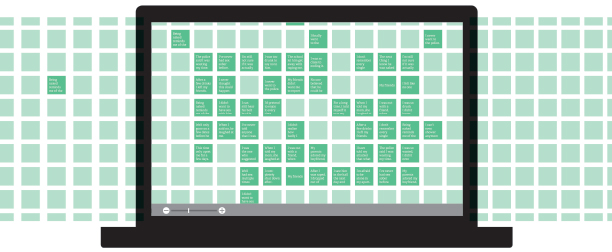
A wireframe of a digital quilt at 75%. Only a small amount of the story is visible to the user.
Although story archives on the web, like blogs, are inherently collections of stories, traditionally they are visually represented in a vertical, linear format, which loses the overall impression of a collection. The patchwork quilt as an interface metaphor offers the perfect opportunity for displaying stories as a collection, where users can view the collection in its entirety or focus on the individual survivor stories.
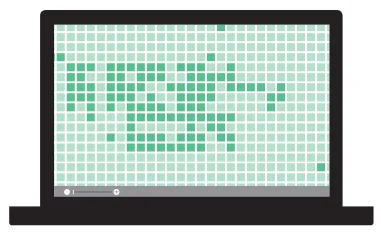
The largest view of the quilt, when the user zooms out at 100%, presents an unfortunate overview of the problem of the date rape on that campus
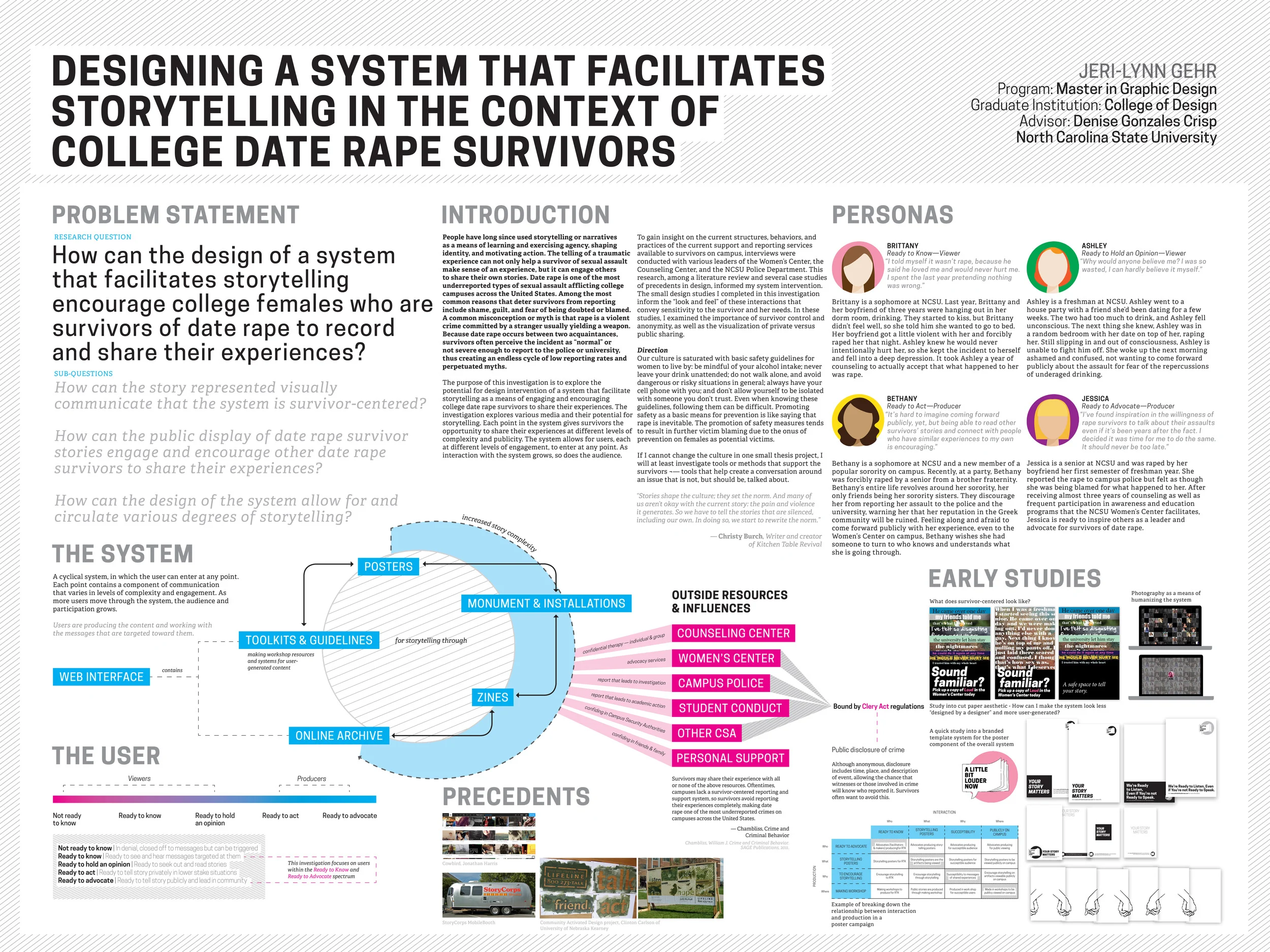
In the Spring of 2015, I was selected to present my thesis project at the 10th Annual NC State University Graduate Student Research Symposium. I was among over 200 other poster presentations from 64 graduate programs at NC State.
Conclusions and Further Work
Due to privacy issues of the users of my investigation, I was not able to work directly with sexual assault survivors. This made the investigation extremely theoretical and somewhat difficult to predict how survivors might use the tools and systems I designed to facilitate their storytelling. Because I was speculating on the visual and textual outcomes of my design studies, the next step is to implement parts of the system into a college environment to see if and how survivors interact with it.
The framework through which I explored visual representation of survivor stories presents opportunities for future work that involves sharing experiences around stigmatized issues. These issues include, but are not limited to individuals with mental health concerns, individuals suffering from HIV and AIDS related illnesses, and victims larger audiences of domestic and sexual violence. Each of these issues presents similar problems regarding the importance of conversation within a community to raise awareness about larger issues.
The investigation suggests opportunities to further examine the visual representation of collective action as a means for communicating survivor-centered and community, in general. The investigation also scratched the surface of how designers can push the boundaries of communication channels in terms of facilitating storytelling. For example, how can designers offer survivors tools that turn a medium that is traditionally perceived as highly public into one that feels safe?